Inside your Student Portal
Your name and student ID, live progress across programs, graded diagnostic labs, and Maya AI tutoring when you're stuck — a short tour of the signed-in Academy.
Play a real lab — no sign-upThe Academy is a lab-based technical training system for people who design, install, service, and lead energy systems — solar, HVAC, storage, and more. You work real service scenarios, commit to decisions, get graded, and earn a professional Academy certificate.
After the labs, you know which exam to book. Study the graded labs, then book the credential that applies where you work. EcoPowerHub Academy is the prep. The examining body is the issuer. Exam fees are paid to them.
Prep forEPRANABCEPEPA 608NATE
See how the Academy trains judgment — a look inside the learner portal and the graded labs, before you enrol.
Your name and student ID, live progress across programs, graded diagnostic labs, and Maya AI tutoring when you're stuck — a short tour of the signed-in Academy.
Play a real lab — no sign-upLab-based technical training for the people who design, build and service advancing energy systems — graded on real field decisions.
Explore training programsEnergy technology is advancing faster than most training can keep up, and a wrong call in the field is expensive. This Academy exists to close that gap — and it is worth being exact about what that means.
There is no video you can leave running. Training happens inside interactive labs built from real service scenarios — the symptoms, site conditions, and constraints you would actually be sent to.
Safety, diagnosis, sequence, and checklist labs mark the decisions you make, not the answers you recognize. A safety failure fails the lab outright — it is never averaged away.
We research the live syllabus for each market and keep the labs aligned to it. When the authority updates the rules, the training is updated — this is material we defend, not a question bank.
The goal is that you walk into the official exam prepared to pass with flying colours — and work clean in the field afterwards. Their job is to issue the credential; ours is the preparation.
Complete a program's required labs, lessons, and capstone and you receive an Academy certificate — our record of your graded work, with a public verification page anyone can check.
Prep here for EPRA, NABCEP, EPA 608, NATE, CEC, SAQCC Gas and ESSCI, then book the exam with that body when the labs are done. EcoPowerHub Academy is the prep; the examining body is the issuer.
The labs are the product. Rather than describe them, here is one from the track — playable right now, no account, no card.
Diagnosis lab
A 5 kW residential multi-MPPT string inverter logs 'Isolation resistance low' most mornings between 07:00 and 09:30, then runs normally all day. Production is down about 9% month over month. The roof is nine years old and the array has two strings. A previous visit has already told the homeowner the inverter needs replacing, and the quote is sitting in their inbox.
The scenario is written the way dispatch would give it to you — symptoms, timing, site age, and nothing else. No hint about which answer is intended.
Pick the moves you would actually make on this visit. Every option is weighted: first-line checks score, time-wasters cost you, and defeating a protection setting fails the lab outright.
You get the evidence that mattered, the trap that leads the wrong way, and the sharper path a seasoned technician would have taken — per option, not a single score.
Graded in your browser. Nothing is saved and no account is created.
Study the graded labs, then book the credential that applies where you work. EcoPowerHub Academy is the prep. The examining body is the issuer.
Brazil: grid and CREA rules vary by state — prep first, then confirm with the local authority. Exam and licence fees are paid to the examining body. Academy completion is training.
Every program runs on the same lab-based standard: real scenarios, committed decisions, graded work, and a certificate you can verify.
The same shared technical core in every market, presented against the authority that matters where you work. Each regional page states plainly what the training prepares you for — and what only the authority can issue.
Code-aware diagnostic labs for U.S. technicians on the NABCEP path — not a replacement for install-yard hours, but a structured way to sharpen judgment before the exam and the inspection. Every call is tied back to the NEC clause behind it: cold Voc, ampacity with correction factors, 705.12 interconnection, rapid shutdown you verify rather than assume. Graded labs mirror the decision order NABCEP expects from PV Associate through PV Installation Professional, with safety-fail marking on unsafe method. NABCEP issues the credential; state authorities license electricians; the Academy provides training and exam prep only.
Built on the shared core: 21 modules · 89 graded labs
Founding price · list $997 · returns to $997 when the exam-practice pass ships
Diagnostic method first, delivered remotely: graded labs you work from anywhere in East Africa, on your own hours, with no cohort dates. You work the way an EPRA or NITA assessor watches you work — sources identified, isolation proved, decisions made in order, and an evidence pack that stands up after you leave the site. Hybrid, battery and grid-tie fault-finding is built in, mapped to EPRA T1–T3 scope in Kenya and to installer expectations in Uganda, Tanzania and Rwanda. The Academy awards a training credential only; EPRA grants the Kenya solar PV technician licence.
Built on the shared core: 21 modules · 89 graded labs
Founding price · list $997 · returns to $997 when the exam-practice pass ships
Regional pricing for this program is only available to learners working in that region, so this enrolment is at the global list price.
Diagnostic method first, delivered remotely: graded solar labs you work from anywhere in South Africa, on your own hours, with no cohort dates. You practise one systematic fault sequence — isolation proved, hybrid and backup behaviour separated from PV and grid faults under load-shedding conditions — and you record it the way an assessor or an inspector reads it: PV GreenCard-aligned checklist evidence captured as you work, and COC-ready documentation that stands on its own. SAPVIA-endorsed assessment issues the PV GreenCard, the QCTO pathway issues the Solar PV Service Technician (NQF) qualification, and a registered person issues the electrical CoC; the Academy prepares you for all three and issues a training credential only.
Built on the shared core: 21 modules · 89 graded labs
Founding price · list $997 · returns to $997 when the exam-practice pass ships
Regional pricing for this program is only available to learners working in that region, so this enrolment is at the global list price.
The shared foundation the three region tracks are built on: 21 modules of graded field work — isolate energy safely, commission to spec, and diagnose live PV, storage and hybrid systems without guessing. Enrol here if no regional track fits your market.
The shared core: 21 modules · 89 graded labs
Founding price · list $997 · returns to $997 when the exam-practice pass ships
Field diagnostics across four paths — residential, commercial refrigeration, rooftop units, and commissioning — held to the same graded-lab standard.
Four open learning paths — residential HVAC, commercial refrigeration/RAC, packaged rooftop units, and installation & commissioning — built on graded diagnostic decision labs with the same safety-fail standard as the solar track, plus timed exam-style mocks and EPA 608 / NATE-style exam preparation. One verifiable Academy certificate per path. Paths E and F are in development.
Two leadership products. One family. Different jobs.
A pilot leadership layer for owners, service managers and supervisors: set the standard, place technicians honestly, supervise without micromanaging, cut callbacks, and run one service flow in EcoService OS.
For leaders working across distributed energy, community solar and virtual power plants. Built for distributed energy markets worldwide, with regional focus pages for Kenya & East Africa, the United States, Australia, Asia and South America.
Two quick picks and we point you at the right preparation — not a licence application. The authority issues the credential; we make sure you walk in ready.
1 — Your market
One shared technical core, presented against the authority that actually matters where you work. Each regional page states plainly what the training prepares you for — and what only the authority can issue.
Same curriculum and grading everywhere, priced for your market. Each market page shows the tracks that are open, what the work looks like locally, and who actually issues the credentials — never us.
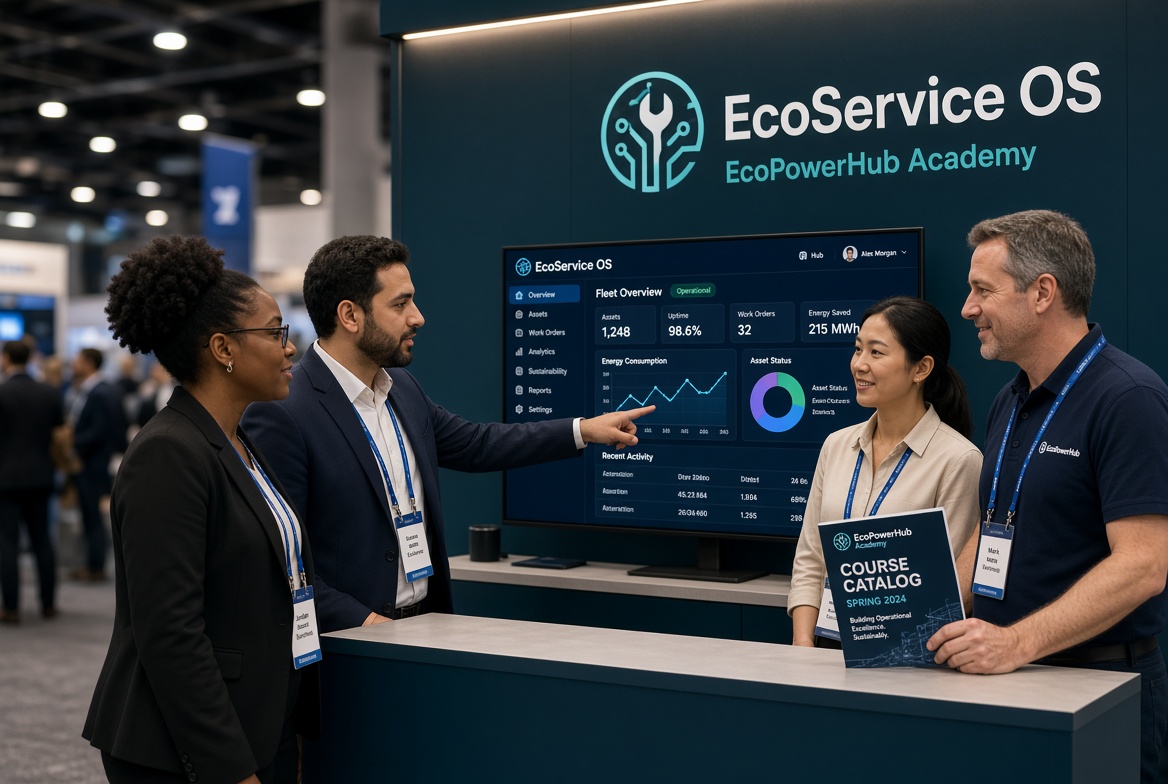
Approved partners get a printable QR tied to their own account. Scan it at the counter and the technician lands on the right track with the referral attached — you earn a disclosed 8% on qualifying sales.
See the partner programEach module opens on a job you would actually be sent to, with the symptoms, site conditions, and constraints you would really face in the field.
Safety, diagnosis, sequence, and checklist labs are marked against what the work actually requires. A safety failure is a failure, not a warning.
Every submission returns the evidence that mattered, the trap that could have led the wrong way, and the sharper path a seasoned technician would take.
One continuous 10.2 kW hybrid scenario with forced gates — safety, then diagnosis, then checklist, then sequence. Pass it and the certificate is issued.
Not claims about outcomes — the standard built into the track itself. You can check every one of these against the syllabus before you pay.
We do not publish testimonials we cannot attribute. This section stays empty until graduates send quotes we are allowed to name — no stock photos, no invented ratings, no composite “typical students”.
Finished the track and happy to be quoted? Email support@ecopowerhub.ai.
How you get access depends on the program. Solar is a one-time purchase, the Service Leadership pilot runs at no charge, the Energy Transition package is open to view and facilitate, and membership adds ongoing support on top of any track you hold.
One price story, presented the same way in every market: the United States, South Africa and Shared Core enrol at the $697 founding price (list $997); East Africa enrols at $397 regional access. Regional program pages carry the details for each market.
You are paying for graded labs, regional physics, and a team that keeps this aligned to the exam you actually book. Exam and licence fees are paid to the examining body.
New to the trade? Start with the global solar technician training guide — what the role involves, what you learn, and the certification path in your country.
$697one time$997
Founding price — Founding price — returns to $997 when the exam-practice pass ships.
The full Solar Technical Training program, every graded field lab, the four-stage capstone, and the certificate. Each track is purchased on its own and stays available for refresher work as systems evolve.
1 technician · $697 each
Discounts: 3–5 technicians 15% off · 6–10 25% off · 11+ 40% off. Need a formal quote instead?
Not sure yet? Play the sample lab first — it costs nothing and takes a few minutes.
Pilotno charge while in pilot
A pilot leadership layer for owners, service managers and supervisors: set the standard, place technicians honestly, supervise without micromanaging, cut callbacks, and run one service flow in EcoService OS.
View the pilotWorkshopopen to view and facilitate
A short course for leaders coordinating distributed energy, community models and cross-regional progress. Read it online, or run it from the printable facilitator guide.
View the module$129/month
How technicians stay current as equipment and systems keep advancing: direct access to senior technical support and new advanced labs as they ship. One membership covers every track you hold, and cancels whenever you decide it has stopped earning its place.
Join the membershipPayments are processed by Stripe. You will be asked to sign in or create an account before checkout so your progress and certificate stay attached to you.
Each technician is enrolled on their own account so lab grades, capstone attempts and certificates belong to them. Pick the number of technicians above to enrol a team at the discounted rate, or request a formal quote.
HVAC Technical Training Paths A–D are open on the same regional pricing ladder as solar. Battery storage, EV charging, appliance repair and industrial maintenance are in development — no pricing is published until a program opens.
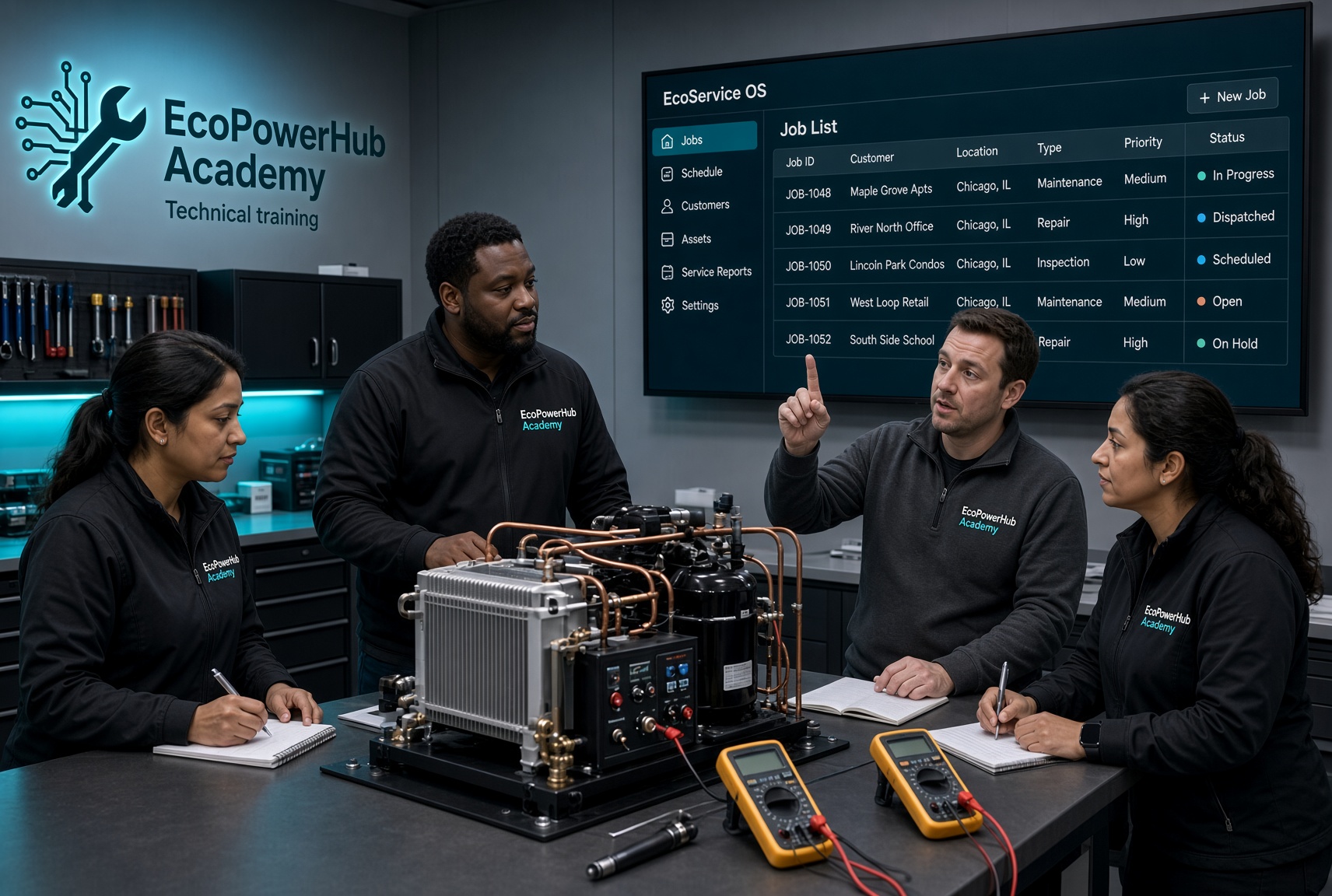
EcoService OS handles dispatch, Maya photo diagnostics, jobs and invoicing — separate from Academy training.
Training does not include a software subscription. Software does not issue a trade credential.